Kantha of Bengal: The Timeless Art of Running Stitch Magic

by | Jan 27, 2026 | Ethnic Textiles, Indian Textiles, Textile Design | 0 comments

kantha of Bengal

The Rich History Behind Kantha Embroidery

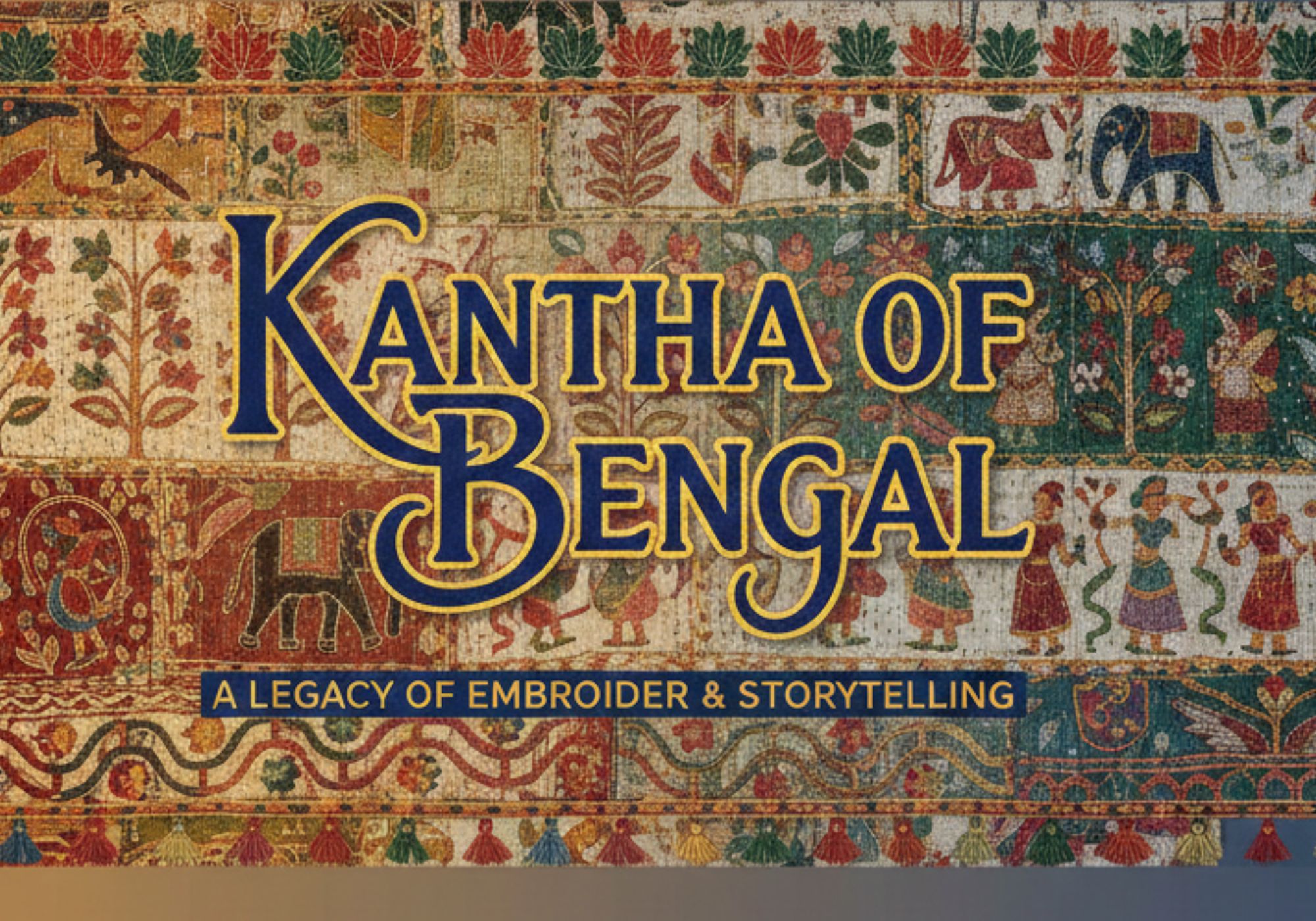
To truly understand the kantha of Bengal, you have to look past the embroidery and see the hands that made it. For centuries, this wasn’t an industry; it was a quiet, domestic ritual. Imagine a rural Bengali home where nothing was ever thrown away. When a soft cotton sari became too thin to wear, it wasn’t discarded. Instead, women would layer these “rags” together, using the colourful threads pulled from the sari’s own borders to quilt them back into life.

This is the soulful heart of the craft—it’s born from a place of deep thrift and even deeper love. The word kantha itself literally means “patched cloth,” but to the women of Bengal, these were repositories of memories. A mother might spend months stitching a small sujni (quilt) for her newborn, or a grandmother might create an arshilata (a wrap for a mirror) for a granddaughter’s wedding.

What makes it feel so human is that no two pieces are ever identical. Unlike machine-made patterns, the kantha of Bengal is intentionally imperfect. You’ll find little irregularities in the running stitches that tell you an artisan was working by the light of a lamp after her chores were done. Each motif—a lotus for luck, a fish for plenty, or a simple bird—is a small piece of her world stitched into yours. When you hold a piece of Kantha today, you aren’t just holding fabric; you’re holding a conversation across generations, a testament to the idea that beauty can be built from the things we once thought were broken.

Durjani Kantha

Understanding the Traditional Kantha Technique

What makes the Kantha of Bengal technique, so hypnotic isn’t just the visual—it’s the rhythm. When you run your hand over a finished piece, you feel that signature “ripple” effect. This isn’t a design choice; it’s a physical byproduct of thousands of tiny running stitches pulling multiple layers of soft, aged cotton together. In a world of stiff, machine-made fabrics, Kantha feels remarkably alive and fluid.

The beauty is in the extreme simplicity. There are no fancy machines or complicated knots here—just a needle, a thread, and a staggering amount of patience. Traditionally, women would sit in the afternoons, unravelling the coloured borders of their old saris to get the thread they needed. It was the ultimate “zero-waste” lifestyle long before that was a buzzword. Because the stitches are done by hand, they are never perfectly uniform. Those tiny, human “imperfections” are actually the artisan’s signature.

If you want to spot a real hand-stitched piece, look at the back. A machine-made copy will look too perfect, almost robotic. But a genuine kantha of Bengal tells a story on both sides. You’ll see the “path” of the needle—the start and stop points, the slight shifts in tension, and the way the motifs like the lotus or the fish seem to grow organically from the fabric. It’s a meditative, spiritual process that turns a pile of old rags into a piece of art that can breathe and move.

Arshilata Kantha

Iconic Motifs and Patterns You’ll Love

When you look closely at a piece of Kantha of Bengal, you aren’t just looking at embroidery—you’re reading a secret, symbolic language. Because these artisans originally stitched from memory rather than patterns, every motif is a direct reflection of their hopes, their surroundings, and their deep cultural roots.

One of the most common things you’ll see is the lotus flower. It’s not just there because it’s pretty; it represents purity and spiritual awakening, often radiating from the center of a quilt like a sun. Then there’s the fish, which is practically a staple of Bengali life. Since the region is defined by its rivers, the fish symbolizes abundance and the “flow” of life. You’ll also spot the “kairi”—those mango-shaped paisleys—which are ancient symbols for fertility and the richness of the earth.

What I find most human about this craft is how it captures the “small” moments. Alongside majestic elephants (for wisdom) and the Tree of Life, you’ll find humble everyday items: clay pots, farming tools, or even a local bird perched on a branch. There’s no blueprint; the artisan just starts stitching her world into the fabric.

Even the colors tell a story—red for the fire of marriage and life, yellow for the joy of spring, and white for peace. When you wrap yourself in a Kantha shawl or carry a Kantha bag, you’re basically carrying a visual autobiography of Bengal. It’s a reminder that even the simplest running stitch can carry the weight of an entire culture’s history.

Bayton Kantha

Types of Kantha You Should Know

It’s fascinating how the kantha of Bengal wasn’t just one single thing; it was a clever, all-purpose solution for every corner of a Bengali home. Imagine a world before plastic or mass-produced cases—Kantha was the answer for everything. If you wanted to protect a sacred book or a valuable manuscript, you’d wrap it in a Baiton Kantha. If you needed to store your mirror or a comb, you’d use an Arshilata.

The most famous variety you’ll come across is the Sujani Kantha. This is the “high art” of the family—intricate, large-scale quilts filled with mandalas and lotuses, often used for ceremonies or as decorative spreads. On the flip side, you have the Lep Kantha. These are thick, heavy wraps made for the damp, foggy winters of the Bengal delta. They aren’t always the most “fancy” to look at because their primary job is to keep you warm, but their weight and texture feel incredibly comforting.

Then there are the smaller, more personal pieces. A Durjani acted as a small wallet or pouch for coins, while a Rumal was a simple, decorated handkerchief. Even your sleep was covered by Oaar Kantha, which were soft, quilted pillow covers designed to be gentle on the skin.

It’s this sheer versatility that I love. It shows that the artisans weren’t just “making art”—they were making life more beautiful and functional. Today, while we might use a Kantha piece as a throw for a modern sofa or a stylish laptop sleeve, we’re still participating in that same tradition of using hand-stitched fabric to protect the things we value most.

Lep Kantha

The Revival of Kantha in Modern Fashion

I’ll be honest—sometimes “sustainable fashion” can feel a bit clinical or overly minimalist. It’s vibrant, it’s textured, and it’s finally getting the global recognition it deserves. If you’ve seen those stunning, quilted jackets on your feed lately, you’re already witnessing its comeback. It’s the ultimate “cool girl” layer because it takes a simple outfit and immediately gives it a soul.

The best way to wear it without feeling like you’re in a costume is to let the jacket be the main event. I love throwing a cropped Kantha blazer over a plain white tee and my favorite worn-in jeans. It’s effortless, but the hand-stitched ripples add this amazing depth that a mass-produced jacket just can’t touch. If you’re feeling a bit more adventurous, a long Kantha duster over a sleek midi dress is a total showstopper for a dinner out.

What’s really heartening is that this “trend” is actually helping real people. By choosing a handmade kantha of Bengal piece, you’re directly supporting female artisans who are keeping their heritage alive while earning a fair wage. It’s fashion that feels good to wear, not just because it looks incredible, but because you know it started as a labour of love in a rural courtyard. Whether it’s a scarf looped over a trench coat or a bold statement jacket, you’re carrying a piece of history that’s been reimagined for right now.

Oaar Kantha

How Kantha Supports Rural Women Artisans ?

There is something deeply moving about the way kantha of Bengal changes the lives of the women who create it. For many rural artisans, these tiny running stitches are more than just an art form—they are a lifeline. In many Bengali villages, women have traditionally relied on seasonal farming income, which can be incredibly unpredictable. Now, through their embroidery, they’ve found a path to financial independence that didn’t exist for their mothers.

What I love most is how this work fits into the flow of their lives. These women often work from their porches or courtyards, balancing their stitching with raising families. When you buy an authentic piece, that money isn’t just going into a corporate bank account; it’s going directly toward school fees for a daughter or better nutrition for a household. It’s female entrepreneurship in its purest, most grassroots form.

You can actually feel the shift in confidence when you talk to these artisans. Many have formed cooperatives, learning how to negotiate prices and manage a business for the first time. It has completely changed the family dynamic, giving them a seat at the table and a sense of dignity that comes from being a primary breadwinner.

The pride they feel when they see someone halfway across the world valuing their work is honestly priceless. It’s a beautiful reminder that our “style choices” aren’t just about us. When you choose a handmade kantha of Bengal piece, you’re helping a tradition survive modernization and ensuring that a woman’s skill is recognized as the treasure it truly is. Your closet gets a masterpiece, and her family gets a future.

Rumal Kantha

Styling Kantha in Your Modern Wardrobe

I’ll be honest—it’s easy to look at a piece of kantha of Bengal and think it’s too “special” or “delicate” for everyday wear. But that’s the magic of it; these pieces were originally made for the rigors of home life, so they are surprisingly tough and incredibly versatile. If you’re wondering how to pull it off without looking like you’re wearing a costume, the secret is all in the contrast.

My absolute favorite way to style a Kantha jacket is the “high-low” approach. Throw a cropped, brightly stitched blazer over a crisp white tee and your go-to distressed jeans. It takes a “running errands” outfit and immediately makes it look like you put in effort. If you’re heading to the office, try a Kantha scarf or stole tucked into a structured trench coat. It adds a pop of texture and color that feels sophisticated rather than overwhelming.

Inside your home, kantha of Bengal is a total game-changer for that “lived-in” luxury look. If you have a minimalist, neutral bedroom, a single Kantha quilt at the foot of the bed acts as a stunning anchor. Even a couple of Kantha cushions on a leather sofa can bridge the gap between modern and traditional perfectly.

The best part? You don’t have to be a fashion expert to get it right. Kantha is eclectic by nature, so it actually rewards a bit of “pattern clashing.” Wear it with denim, linen, or even silk—it’s one of those rare materials that just plays well with others. Just put it on, stop overthinking it, and let the hand-stitched stories do the talking.

Sujani Kantha

10 Frequently Asked Questions About Kantha of Bengal

 What exactly is Kantha of Bengal?

Kantha of Bengal is a traditional embroidery technique from Bengal, India, and Bangladesh. Artisans create it by layering old cotton sarees and stitching them together. The running stitch creates both functional quilts and decorative textiles. Kantha is the sustainable craft that recycles the fabrics into the useable art. You will be able to identify the authentic Kantha by its slightly puckered texture and hand stitched patterns. This tradition dates to the centuries and then pass through generations of the Bengali Women.

How much time does it take to make one Kantha piece?

The Kantha of Bengal needs tremendous patience and the dedication from the artisans. If you are making a small piece of cushion, then it may take 2-3 weeks of consistent work. For the larger items such as bedspreads and sarees it takes 2-3 months to complete. When you buy a Kantha, you purchase hundreds of hours and skilled handwork in each piece. The time keeps changing according to the complexity and stitch density. This explains the difference between price of the premium authentic and machine-made Kantha.

Can I wash my Kantha textiles at home?

Yes, you can wash the Kantha of Bengal at the home with proper care. Wash the cloth with chemical free detergent and cold water. Do not use bleach or any harsh stain removers for the delicate fabric. You need gently squeeze the fabric and remove the water Dry in a flat shade and avoid the direct sunlight which will fade the colors. You can iron the fabric at the reverse side only. This will help you to keep the Kantha pieces for generations.

What’s the difference between Kantha and regular embroidery?

Kantha of Bengal uses the running stitch throughout the entire piece. The stitches hold the fabric layers together and it serves the functional and decorative purpose. Kantha also recycles the old textiles and makes a new fabric. The artisans here work without patterns and create designs from the memory and cultural knowledge.

Why are the Kantha Prices different?

Kantha OF Bengal prices varies due to several factors. Authentic handmade pieces cost more than machine made imitations due to the complexity of the design and stitch density. The size also affects the price with design. You also pay more for the pieces from established artisans cooperative ensure fair wages. The antique Kantha or the vintage one demands the premium prices due to the rarity. The materials used such as silk or cotton or any other also influence the prices. You also need to understand that you are purchasing an art with labour and cultural preservation.

 Is Kantha Suitable for all the climate conditions?

Yes, Kantha of Bengal is suitable for all the seasons and the climate. The traditional Kantha gives breathable warm and is perfect for the moderate temperatures. The Lep Kantha provides the breathable for the moderate temperatures and the thick one for the cold winters. You can select the stitch density of the Kantha based on the climate needs.

How can Kantha be displayed as home décor?

Kantha Of Bengal makes the home décor statements special and throughout the space. You can hang the large vintage Kantha as the tapestries or the wall art in your living area. You can also drape the throws over the chairs, sofas and colourful accent. The Kantha cushions can add global flair and add texture to the neutral furniture. The panels of smaller Kantha can be used as the dining and console tables. These versatile textures complement the bohemian and minimalist interior style.

What makes Kantha sustainable fashion?

Kantha of Bengal embodies sustainability principles that modern fashion desperately needs! It traditionally upcycles old sarees into new, functional textiles. You’re choosing biodegradable natural fibres over synthetic petroleum-based fabrics. The hand-production process uses zero electricity or industrial machinery. Natural plant-based dyes replace harmful chemical colorants in traditional Kantha. You support local economies and women’s empowerment with each purchase. The timeless designs never go out of style, encouraging long-term use. Kantha represents everything slow fashion advocates promote!

Related Posts

The Art of Khakha Making

The Art of Khakha Making

Khakha Making Khakha making is one of the traditional Indian crafts techniques. It is used to transfer the intricate embroidery design on the fabric. A perforated paper stencil also known as “Khakha” is used for this method. The term “Khakha” also known as Khaka...

read more
error: Content is protected !!