
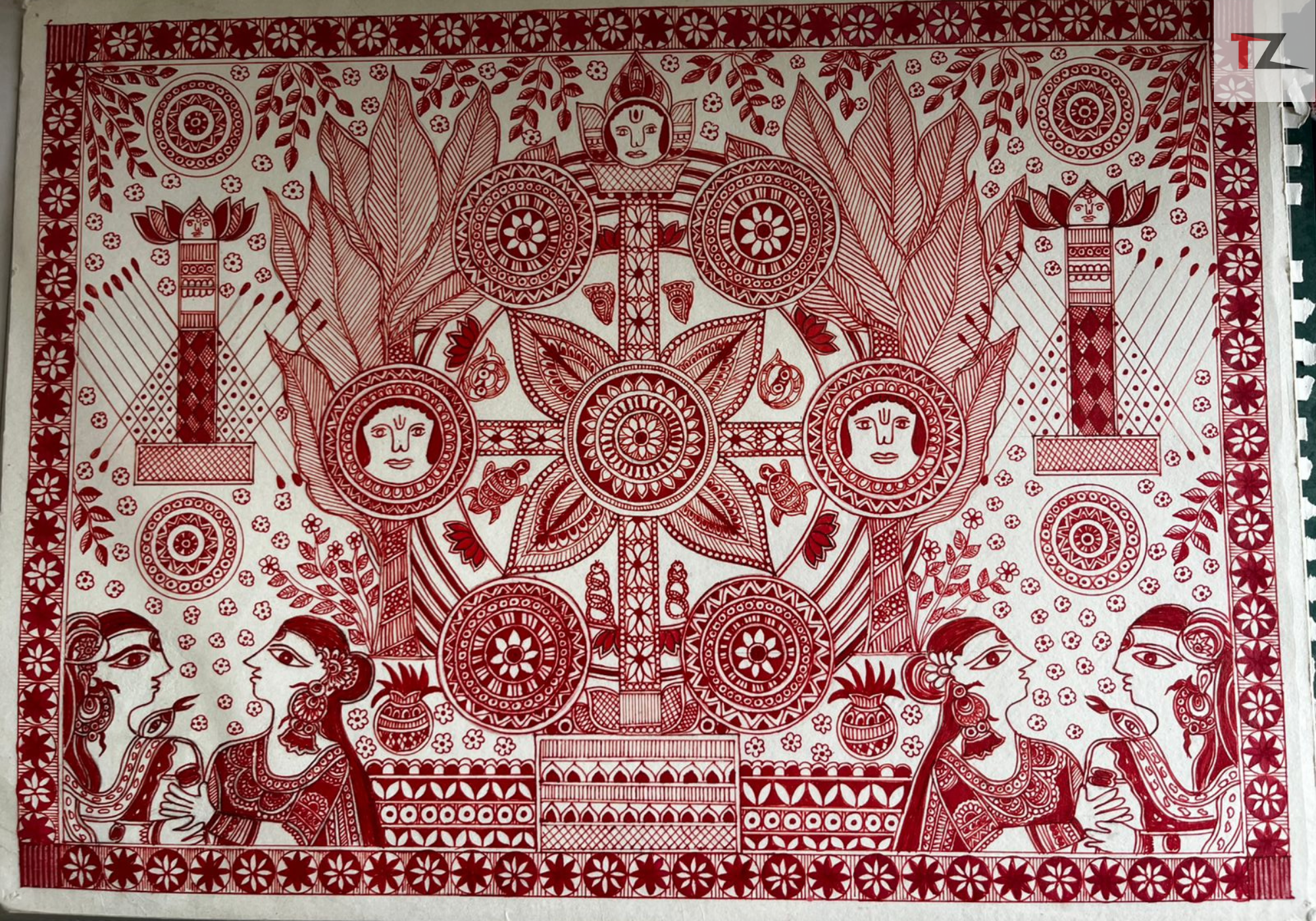
In the heart of Mithila lives a tradition of art and rhythm where the sun kisses mud walls with cow dung and rice paste. This is Khobar Madhubani which is an ancient art form that drones with symmetry and spirit. It is not just a decoration but is a design with devotion. It is a ritual geometry with a sacred dialogue that goes in between colour, culture and creation. Every motif here carries a meaning and every repetition becomes rhythm.
The “Khobar Ghar” also called as “nuptial chamber”, describes a canvas of whispers and wishes earlier. These were painted by the women who never had been to art school but they yet mastered the proportion, repetition and balance with an instinctual precision. They used brushes which were twigs, colours were their earth and rulers were the intuition. And yet those earthy lines were so perfect that every designer, artist and aesthete may learn from them the features such as the rhythm of geometry, the discipline or repetition and poetry of colour.
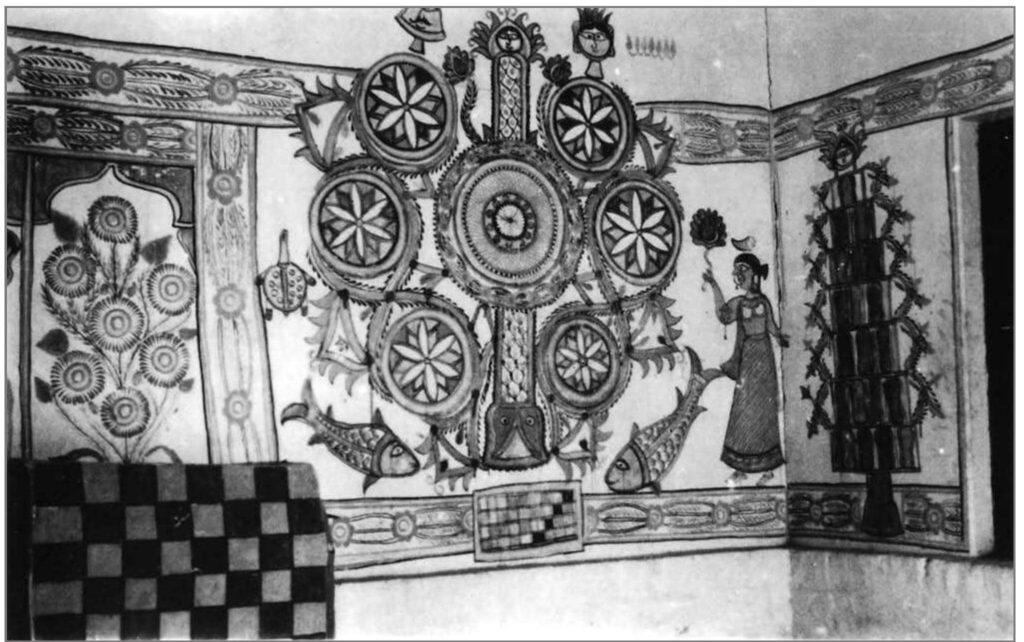
The Colour of Creation: Why Red Rules the Khobar Madhubani?
Red colour in Mithila is not just a colour; however it is the symbol of fire, fertility, auspiciousness and continuity. This colour becomes the code for the new beginnings and sacred feminine energy that bonds all living forms. Earlier natural colors were used not the Red synthetic. The red was obtained from GERU (Red Ochre). Red of life from the earth and then grounded into fine paste. Then it was mixed with water or even cow dung so that it holds intensity. It also resembles the energy. In every painting of Khobar red forms the base with the outlining of the motifs such as lotus, fish, peacock and the sun as common motifs. It is called the colour of creation.
The women who used to paint this wall not only meant decoration to them but also devotion. In Khobar these motifs anchors the spiritual intention. The red anchors the eye and it establishes the emotional focus. The motifs of Khobar Painting outline red with a deliberate stroke and every curve a prayer. There is a union of motifs together, the lotus blooms at the center with the sun’s expanding rays and the serpentine vines wrapping around the couple’s symbolic union. For the modern artists this might be a colour strategy, a dominance to evoke emotion however for the Mithila women it’s an invocation. The wall was not just a painting but it was consecrated.
Symmetry and Spiritual Balance
The main design principle at the heart of Khobar is the Symmetry. The wall mirrors them starting from the left to right and top to bottom. They represent the harmony between the bride and groom, masculine and feminine, divine and human.
The center consists if the motifs such as sun or lotus and it are surrounded by the concentric layers of vines with birds and borders. They create what modern artists will call as Mandala of Meaning. This is not the mathematical symmetry but the spiritual symmetry. Each repetition brings the balance, calmness and visual rhythm. It is a design that is rooted with principle in emotion rather than the precision. Khobar geometry breathes feeling into structure. If you look closely you will find a perfect bilateral symmetry with mirrored patterns and circular balance with radial harmony that radiates from the center.
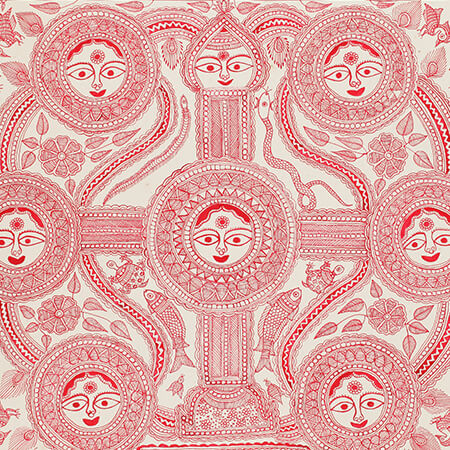
Balance and unity, these are the core essence of marriage and this symmetry represents the same.
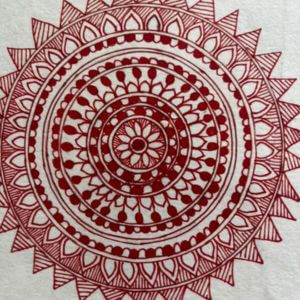
How the Motifs Work Together?
The mandala-like arrangements begin with a central motif. The center motifs such as lotus, sun, tree of life form the spiritual axis. The middle motifs include the peacock, fish, snake and parrot which creates the rhythm and energy. The outer motifs include the borders, Lakshmi feet, floral vines and provide protection and closure. All these form a pattern language that feels totally hypnotic. Khobar is said to be a dance of geometry, where every curve leads to the eye to its opposite and every circle return to its origin. Some of the design theorists might call it a visual rhythm however in Mithila it the geometry of blessings.
The Motifs with their Meaning in Khobar Madhubani:
Fauna Motifs :
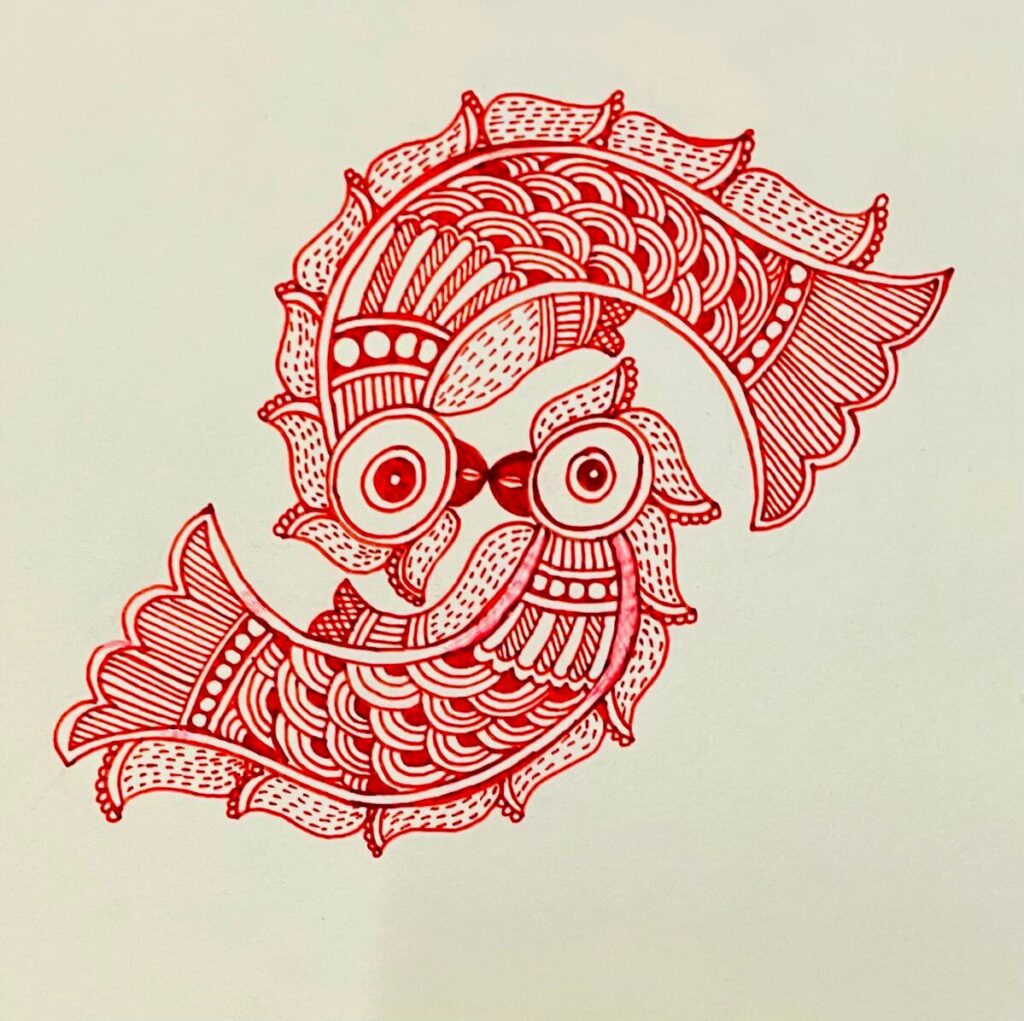
- Fish – (Machali)- Represents fertility abundance, and life’s continuity.
Fish are symbolized as carriers of good fortune and growth. They represent the marital harmony. Repetition of fish creates visual rhythm and flow — a metaphor for movement and fertility.
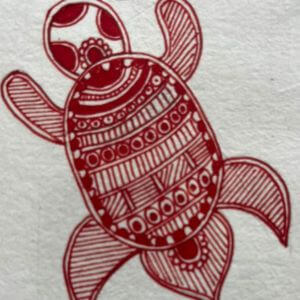
- Tortoise (Kachhua) – Stability, patience, and protection.
The tortoise represents the grounding energy in home and marriage. It is the endurance and longevity if relationships that is drawn as concentric ovals and its ornate the shells with balance in symmetry in an organic form.
- Peacock (Mor) – Beauty, Desire and Divine Connection
Peacock symbolizes the love and monsoon. It signifies the romance and the joy of union. It adds a decorative flair and movement to the compositions with its graceful curves and rhythmic feathers.
- Snake (Naag or Sarpa)- Fertility, Cosmic Energy and Protection
Snakes are the guardians of scared spaces and they symbolize the cyclic renewal. In marriage rituals they bless the union with endurance and strength. Protective boundaries are created due to this flowing and wavy lines created by the serpentine rhythm.
- Parrot and Other Birds – Communication, Harmony
Birds carry the voice of love and gods and they symbolize the companionship and devotion.
- Scorpion (Bichchhu)- Sensuality, Desire
It is linked to the love and passion between newlyweds. Its presence on wall depicts as a reminder of physical connection and a charm of fertility.
- Butterfly (Latpatia)- Change, Growth, and Rebirth
It symbolizes the bride’s transition from her parental home to the beginning of the new phase of life.
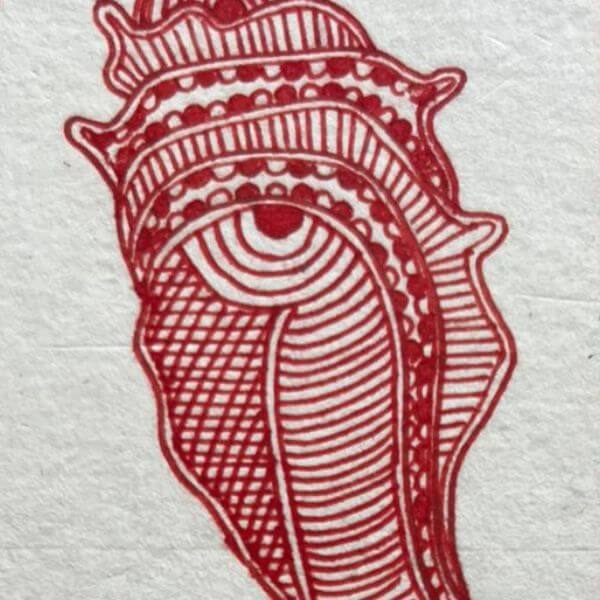
- Conch (Shankh)- Auspicious sound of creation and divine awakening:
It symbolise for the blown in rituals for positive energy into marriage space. In design it creates a visual rhythm and blends sound and form through the design.
- Elephant (Haathi)- Royalty and Auspiciuos Beginning , Power
It represents the strength with protection and marks the grandness if wedding rituals.
- Cow and Calf (Gau Mata)- Divine Motherhood, Nurturing
Cow is sacred and it represents the abundance with nourishment for family life.
Flora Motifs in Khobar Madhubani:
- A lotus (Kamal) – It symbolizes creation, purity, and divine feminine energy.
The lotus is central in most Khobar compositions — representing fertility, spiritual awakening, and the union of male and female principles. This is often drawn with multiple concentric layers (mandala form), radiating rhythm and symmetry
- Bamboo (Baans) – Linage, Fertility and Growth
Bamboo represents the continuity of family and the prosperity. It represents the continuity of family and prosperity. When you use bamboo repeatedly it creates the vertical stalk and bring balance with structural rhythm.
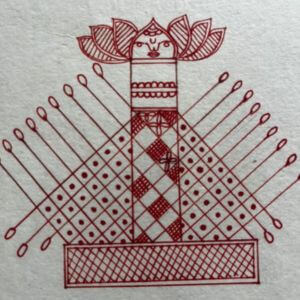
- Tree of Life (Jeevan Vriksha)- Growth and connection between heaven and earth
This cosmic tree embodies the life and regeneration with family roots.
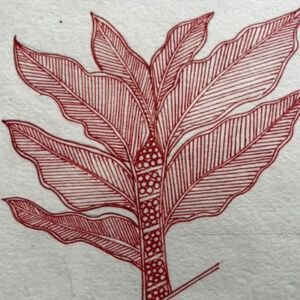
- Floral Borders and Vines (Lata-Patta)- Interconnectedness , Continuity
Its protects the central motif and symbolizeped the life’s endless flow. In a design it continues to loop and crate rhythm and movement
Human Figures & Sacred Motifs in Khobar Madhubani:
- Kalash (Kumbh or Sacred Pot)- Fertility & Prosperity
The Kalash represent the womb of the universe and it is a vessel that holds the amrit that is the nectar of life. It is believed to have the five elements such as water, earth, air and fire with ether.
- Sun (Surya) – Radiates the divine Masculine Energy.
The Sun god blesses the marriage with vitality, protection, and continuity. It is depicted in concentric circles or triangular rays symbolizing cosmic rhythm.
- Moon (Chandra)- Emotional Harmony, Feminine Cycles, Calmness
The moon compliments the sun and it represents the brides energy with balance and intuition
- Lakshmi Feet (Padchinh)- Presence of Goddess Lakshmi – Blessings, Fertility and Wealth
It is drawn at the entrance within the Khobar Room to invite the divine energy.
- The Bride and Groom (Dulha–Dulhan)- Union, Divine Harmony, Fertility
It is the central focus of the most Khobar paintings that is the couple figures which are not portraits but also sacred archetypes.
- Women Figures: Shakti, Protection, Fertility
The female figures are seen in the compositions of performing rituals and offering flowers and surround by auspicious symbols.
- Divine Figures: Spiritual Balance
Gods like Shiva-Parvati and Lakshmi appears as witness to sacred union. They embodied marital bliss and symbolize good fortune.
- The Artist Hand: – Artist Herself
In a Maithili Woman painting symbolizes her hopes and cultural memory. The figures with the elongated nose, large almond eyes and minimal perspective represent both folk stylization and spiritual depth.
Repetition as Ritual, Not Routine
In Khobar the repetition is sacred. When the artists paint the number of fishes or lotus petals repeatedly they do not count they chant them through colour. Every repeat is the mantra and every stroke is the prayer. In this way the wall starts to pulse with a visual rhythm. The main difference between today’s designers and Mithila Women use repetition is they used for the continuity of life. It is the intention which differs between design and ritual. Modern design schools teach the repetition as a principle of harmony however in Khobar Madhubani there is no such rule it is just a ritualistic art. Mithila is simply a living art that is blessed with your love, sleep and balanced homes energy.
Pigments of the Earth: The Natural Design Palette
Khobar Madhubani was already practising the eco-art centuries ago before it could become a trend. Colours came from the earth and the kitchen. Red was the dominant colour used and obtained from Geru. Besides sometimes other colours were used to fill the designs. For the yellow they used Turmeric for the blue they used indigo and soot for the black with green from the leaves. Cow dung was used for the wall base with mud. They created the natural texture for longevity. Every pigment had own meaning.
- Red the main colour from Geru- Use for fertility and Energy, Sacred Feminine
- Yellow (Haldi)- For Health and purity
- Green (leaves) – Growth and Prosperity.
- Black (Charcoal)- Protection
- Blue (Indigo)- For divine cosmic energy.
Each pigment was selected with its meaning and interaction with the space. The Khobar Ghar was designed as living temple with its wall painted to breathe life and protect the union.
The Feminine Grammar of Linework
The lines in Khobar are never static and they are fluid, organic and endlessly looping. No space is left blank and this principle is called as “Bhitti Bharan” or Filling the Wall. Each and every dot and curve connects to the next which creates a visual rhythm. The organic flow of mirrors represents the feminine force of creation with nurturing, flowing and cyclical movement. The lines in a Khobar are not just a boundary but it encloses and expands at once with repetition of loops that it creates, that are a texture rhythm.
It ensembles the philosophy of modern visual design- where “never let negative space feel lifeless; give it meaning”.
From Wall to Weave: Inspiring Modern Design
Today in modern world Khobar motifs leapt off the rural walls and now has come to textile and fashion design. The textile designers have remade the lotus mandalas to block prints. They also transform the lotus grids to handloom weaves. Architects do borrow the radial symmetry for sacred interiors. Graphic designers also use colour geometry to tell the brand stories which are rooted in the culture. It is said that geometry meets emotion, design meets devotion. However in recent year Khobar sacred geometry has been leaped from mud walls of Mithila to the modern design disciplines such as digital illustrations, home décor, textile and fashion. The rhythmic symmetry of Khobar proves to be the timeless art built on the universal principle of harmony and proportion.
The Design Lesson Hidden in Ritual Walls
Khobar Madhubani and its element carry a timeless lesson for the modern creative mind as below:
- Reputation is the rhythm and is not a routine. It can be spiritual, Design is a rhythm and it is not monotony. Ritual helps transform repetition to meaning.
- Colours has emotion, it carries energy and just not beauty. The Red colours speak louder than words and used with a purpose.
- Symmetry makes a connection between spirit and space. It is not rigid but is a balance. Balance is an emotional harmony and more than visual.
- Sustainability is a tradition and not a trend.
- Nature has been always a part of design system.
- Design is devotion and when you create with an intention even geometry becomes sacred.
- Geometry reminds that the structure can be soulful.
To study Khobar you need to understand that design is not separated from the life. It is woven into the way people pray, live and love life. When you paint Khobar it is not just filling space but also filling life with a meaning.
A Living Geometry
Khobar Madhubani is a living geometry and is more than a relic of ritual. It continues to evolve from rural wedding walls to the urban studios to fashion.
The red of Madhubani still pulses and the rhythm still breathes and the geometry still teaches that language of art is in the line between ritual and design which was never meant to be drawn.
As a conclusion Khobar is not just seen but it is felt. It moves to the rhythm older than the time and when you keenly look at it you will realize you are not only observing art but also listening to it.